

If you’ve spent months grinding through five-day gym splits with nothing to show for it, Mike Mentzer workout routines offer a completely different philosophy. Mentzer, a bodybuilding legend from the 1970s, built his entire training system around one radical idea: less is more, as long as the intensity is brutal. His Heavy Duty training method threw out high-volume workouts in favor of short, infrequent sessions taken to complete muscular failure.
This article breaks down exactly how that system works. You’ll learn the actual training split Mentzer used, which exercises made up his core routine, and why he insisted on sometimes just one working set per exercise. We’ll also cover how often he trained each muscle group, since recovery time was just as important to his method as the workout itself.
Whether you’re stuck on a plateau or just curious why a man who trained a few hours a week built one of the most respected physiques in bodybuilding history, this step-by-step explanation will give you a clear picture of Heavy Duty training and how to apply its principles to your own routine.
Why Mike Mentzer’s Heavy Duty method still matters
From bodybuilding heresy to scientific validation
Back in the 1970s, gyms were obsessed with volume. Guys trained six days a week, hammering each muscle from a dozen angles because that’s what the top bodybuilders seemed to do. Mentzer looked at that model and called it nonsense. He argued that muscle growth happens during recovery, not during the workout, and that piling on sets past a certain point just digs a deeper hole your body can’t climb out of, an idea echoed by research on why lifting weights outperforms cardio for lasting fat loss. Decades later, exercise physiology backs him up: research on training to failure and supercompensation shows that a muscle pushed to genuine exhaustion needs far less total volume to trigger adaptation than most lifters assume.
Mentzer’s core insight was simple: intensity and volume are opposites, and you can’t max out both at once.
Why lifters still turn to Heavy Duty today
Beyond the physiology, Heavy Duty solves a problem most people actually have: not enough time or recovery capacity to sustain a punishing five-day split. Anyone juggling a job, kids, or a second workout goal appreciates a time-efficient training style that asks for two or three short sessions a week instead of ten hours in the gym, much like quick workouts built for busy professionals. Older lifters and anyone managing joint wear also gravitate toward it, since fewer total sets mean less cumulative wear on tendons and connective tissue compared to constant high-rep grinding, which is why it appeals to people starting strength training after 40.
Still, Mentzer’s real legacy is how his ideas leaked into mainstream fitness thinking. His protege Dorian Yates used a modified version of Heavy Duty to win six Mr. Olympia titles, proving the method could build elite mass, not just theoretical gains. Today, versions of his approach show up under labels like high intensity training (HIT), and you’ll find echoes of it in any coach who warns clients against chasing soreness and instead pushes them toward measurable strength progression. Anyone researching Mike Mentzer workout routines today is really asking the same question he asked fifty years ago: how little can you do and still grow? The answer, according to his career and the lifters who followed him, is a lot less than the fitness industry wants you to believe.
How to structure a Heavy Duty workout
The core principles of a session
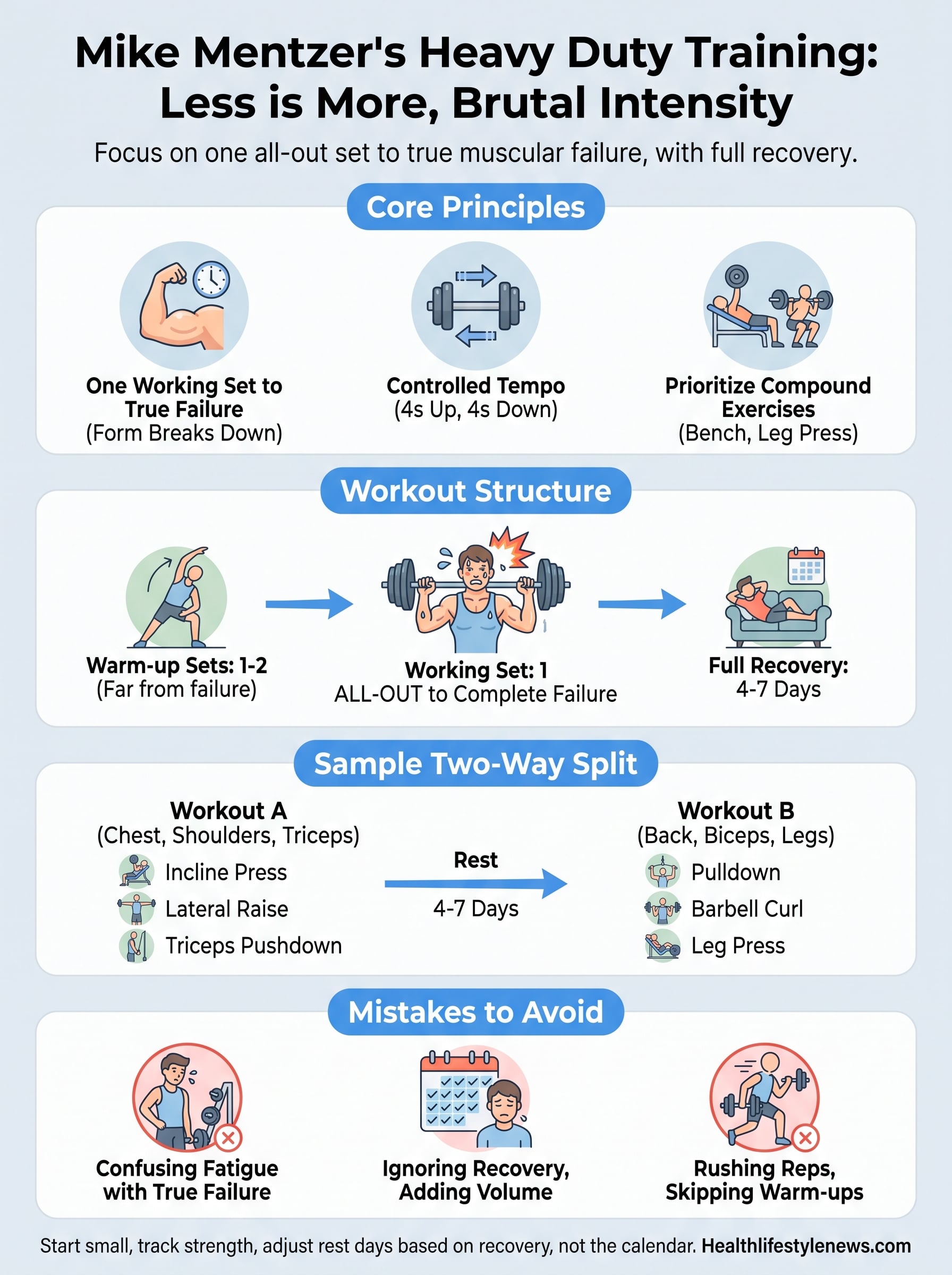
Structuring a Heavy Duty workout means stripping away everything except the exercises that do the real work. Mentzer picked one or two compound movements per muscle group, like the bench press or the leg press, and treated everything else as accessory. Each exercise gets a single all-out working set, performed only after a brief warm-up set or two to prime the joints without pre-fatiguing the muscle. Sets end when you physically cannot complete another rep with good form, not when you hit an arbitrary number like 10 or 12.
One brutal set, taken to true failure, beats five mediocre ones every time.
Rep tempo and session length
Speed matters as much as effort. Mentzer wanted controlled, slow reps, roughly four seconds up and four seconds down, so momentum never bails you out. That tempo alone turns a set of 8 reps into a genuine test of muscular endurance. A typical session runs 30 to 45 minutes because there’s no wasted time between sets; you move with purpose and leave once the work is done.
Here’s the basic structure for any single Heavy Duty workout:
- 1-2 warm-up sets per exercise, far from failure
- 1 working set per exercise, taken to complete failure
- 4-second concentric, 4-second eccentric rep tempo
- 1-2 exercises per muscle group, prioritizing compound lifts
- Full recovery, often 4-7 days, before hitting that muscle again
Sample Mike Mentzer workout split
The classic two-way split
Mentzer built most of his career around a simple two-way split that hit the whole body across two distinct workouts, alternating between them every four to seven days. Workout A targeted chest, shoulders, and triceps, while Workout B covered back, biceps, and legs. This arrangement let each muscle group recover fully before its next assault, which mattered more to him than hitting the gym on a fixed weekly schedule. Some weeks you’d train twice, other weeks three times, depending entirely on how quickly you bounced back.

Train each muscle once every four to seven days, and let recovery decide your calendar, not the clock.
A sample two-day rotation
Below is a simplified version of the split many lifters use as their entry point into Mike Mentzer workout routines, based on his later Heavy Duty writings.
| Day | Muscle Groups | Sample Exercises |
|---|---|---|
| Workout A | Chest, Shoulders, Triceps | Incline press, lateral raise, triceps pushdown |
| Rest | 4-7 days | Full recovery, no training |
| Workout B | Back, Biceps, Legs | Pulldown, barbell curl, leg press |
| Rest | 4-7 days | Full recovery, no training |
Rotating through this way, you might only train four to six days total in a month, yet each session demands total effort. That trade-off, fewer sessions for maximum output, is the entire premise behind his high intensity training philosophy.
Mistakes to avoid when training Heavy Duty style
Confusing fatigue with true failure
Many lifters think they’ve hit muscular failure when they’re just tired, so they rack the weight a rep or two early and wonder why growth stalls. Real failure means your form breaks down completely, not that the set feels uncomfortable. Mentzer was strict about this distinction because a Heavy Duty program only works if that single set actually reaches the threshold that triggers adaptation. Cut the set short and you get the drawbacks of low volume without the payoff of true intensity.

A set that stops before real failure isn’t Heavy Duty, it’s just a short warm-up.
Ignoring recovery and sneaking in extra volume
Overriding the rest schedule is the most common way lifters wreck this heavy duty workout routine. Adding an extra exercise “just in case” or training a muscle after only three days defeats the entire premise, since Mentzer’s system depends on full recovery before the next assault, and rest days do more for your results than extra sets. Skipping proper warm-up sets is another trap, since jumping straight into a max-effort set on cold joints invites injury rather than gains.
Watch for these common errors:
- Ending sets before true failure out of habit or hesitation
- Adding accessory exercises beyond the core one or two lifts
- Training a muscle group again before full recovery
- Rushing reps instead of holding the 4-second tempo
- Treating Heavy Duty as an excuse to skip warm-ups entirely
Steering clear of these habits keeps the method’s intensity intact.
Making Heavy Duty work for you
Mike Mentzer built a training system that rewards discipline over endurance. You don’t need ten hours a week in the gym to grow; you need one true all-out set, strict form, and the patience to let your body actually recover before you go again. That’s the whole argument behind Heavy Duty training, and it’s why lifters still return to his writings decades after his last Mr. Olympia appearance.
Start small if this approach is new to you. Pick one lift per muscle group, push it to genuine failure, then walk away and let recovery do its job. Track your strength every session instead of chasing soreness, and adjust your rest days based on how you actually feel, not a fixed calendar.
If the gym isn’t part of your week, take the same one-set-to-failure discipline into full-body strength training at home with no equipment and build a routine that fits your real life.


